Showing posts with label SABAP2. Show all posts

23 May 2010

International Biodiversity Day 2010

22 May is International Biodiversity Day – and we celebrated the day in a very special way in the veld. The day started early with chilly temperatures, but by 07:45 the mistnets were up and the ringing started in all seriousness. A good diversity of birds were caught and ringed. We had four retraps at a site where not that many birds had been ringed before – so the research project is paying off already with a good number of retraps. This shows that these species frequent that area and have not dispersed far beyond this piece of natural habitat along the banks of the Orange River. Species recaptured were: Orange River White-eye, Southern Red Bishop, Southern Masked Weaver and Karoo Thrush. Other species ringed included Karoo Prinia, Neddicky, a good number of Red Billed Quelea and Cape Robin-Chat. 61 species were totalled for the SABAP2 data sheet.

Burchell's Courser showing the blue-grey head

A farmer in the district alerted me about a pair of Blue Cranes that had settled on his farm. So in the afternoon we went to investigate. We atlased the pentad as well – and had a few very special sightings. On the way to the area where the Blue Cranes settled, ElsabĂ© had good luck to photograph (though a bit far off) Burchell's Coursers. There were 5 birds in the small flock and this observation was a first for the pentad. The Blue Cranes were nowhere to be found in their usual spot.

We moved to a lucerne field under pivot point irrigation – and here we got a few good surprises. The Blue Cranes were foraging in the newly established part of the field. We could get near enough to get a decent pic or 2. A little way off (out of camera range) a pair of Grey Crowned Cranes were feeding. These birds had been observed here more than once before. And to our surprise a single Ludwig's Bustard was patroling the short karroid shrubs just off the edge of the irrigation field. This was a very first for this area. Two korhaan species were seen as well in the shrub and grassland around the same pivot – Northern Black Korhaan and the endangered Blue Korhaan. The last special sighting of the day (with dusk setting in fast) was a single Lanner Falcon quartering the area for prey. Large numbers of Egyption Goose as well as Spurwinged Goose were observed as well. A total of 53 species were counted for the SABAP2 data sheet.

Blue cranes - national bird of South Africa

It is interesting to see the terrestrial living birds – large and small – re-establish themselves in areas where farming becomes more conservation and environmentally friendly. Where farmers do not allow hunting with dogs, even the small bird species like pipits and larks become more abundant as they are not disturbed too much by people moving through the veld with packs of hunting dogs.
Photo's: Elsabe van der Westhuizen

13 January 2010

A very special bird on my doorstep

We currently experience an irruption of African Openbills (Anastomus lamelligerus) all over South Africa – the latest report being a rather bedraggled figure at Shelley Point on the West Coast. Birds had been observed at Durbanville in the Western Cape, along the southern coast (Arabella, Gansbaai, between Mossel Bay and Oudtshoorn, Plettenberg Bay, near PE and Gonubie), a whole lot of spots in KwaZulu-Natal. Even in the interior birds were reported – in the Karoo, near Barkly East and Elliot in the Eastern Cape, in Lesotho and the Free State. The first signs of the irruption had been a small flock of this species observed in Potchefstroom.

Early this morning a local birding friend stopped me in the street to inform me of a single Openbill at dam at our local golf course in Aliwal North. I had been on leave and missed out on the other sightings at the spots near my holiday places. After my return home I had been looking around in the district at the different farm dams and wetland areas to which I have access but to no avail. I just had the feeling one (or a couple) of these birds should be around if it had been spotted all over the country. Great was my surprise to discover one less than 500m (as the stork flies) from my home.

Unfortunately the lawn mowers were cutting grass at the golf course and the bird did not afford me decent pics – the only proper ones I got were of a soaring bird. Fortunately Hugo Brewis, who alerted me, sent me the photo below – I place it on the blog gratefully. Thanks, Hugo, and thanks for allowing us to share in the view of this magnificent bird.
African Openbill at Aliwal North (Photo: Hugo Brewis)

A few other interesting sightings the past week or two while out atlasing for SABAP2 in the district were: a single Black Stork (Ciconia nigra), two sightings of European Rollers (Coracias garrulus) to the north and south of town, a single Lilac-breasted Roller (Coracias caudatus). We also spotted two Blue Cranes (Anthropoides paradiseus) in a pentad where they were a new addition to the species list of the pentad. In the same pentad a walk in the veld produced a Black Harrier (Circus maurus) flushed from the grass and a Rufous-chested Sparrowhawk (Accipiter rufiventris) that flew from a high tree – two more new species to a species list that counted more than 140 species already.

Local birding can certainly be just as exhilarating as travels to exotic destinations and bird atlasing certainly increases the awareness towards new species in the area that is being atlased.

04 September 2009

Short-toed Rock-Thrush got a new bangle

On 29 August BirdLife Free State had a birdringing day at Kloofeind south-west of Bloemfontein. The morning started out quite chilly, but later the day turned out to be a very nice late winter day (or should we rather call it an early spring day?).

Male Short-toed Rock-Thrush in ringing process (Photo: Dawie de Swardt)

On arrival at the site the calls of a Short-toed Rock-Thrush (Monticola brevipes) were heard. It was spotted where it worked the area around an old klipkraal for early titbits. Snaptraps were set and put out in the area where the Thrush had been spotted and very soon afterwards the first special bird for the day was in the trap. It was a male bird and it got it's very unique bangle with the number CC94704 on the right leg. It was very obliging and posed after receiving the bangle for a few photos, after which it had been released.

Other special birds that were ringed were the pair of Pririt Batises (Batis pririt) - both the male and female birds - they were caught in the mistnets. It was very interesting to see (and hear) the fierce pose these small birds put up when handled at the nets and while ringing. For such a small bird, weighing a mere 7,5g, they made quite a lot of noise and snapped their small bills angrily while they were handled. Fortunately they were released very quickly after receiving their bangles to go about their own ways.

A number of Acacia Pied Barbets (Tricholaema leucomelas) were netted through the morning, as well as a female Namaqua Dove (Oena capensis), Fiscal Flycatchers (Sigelus silens) and the odd Familiar Chat (Cercomela familiaris) in a snaptrap. Other birds for the day included a Kalahari Scrub-Robin (Cercotrichas paena) and Chestnut-vented Tit-Babbler (Parisoma subcaeruleum).

Close up of Short-toed Rock-Thrush (Photo: Dawie de Swardt)
The other highlight of the day was a Long-billed Pipit (Anthus similis) that had been tricked into the snaptrap. The bird was spotted where it patrolled an open grassy area with small rocks and sparse bushes. Snaptraps were set out in different spots in that area and in the end the bird could not resist the wriggling mealworm in the trap. The pipit had been bangled (CC94706) and after a photoshoot had been released again.

A total of 21 birds had been ringed and two recaptures of birds ringed before at this site had been made.

The pentad had been atlased as well for SABAP2 and a total of 58 species were counted in the pentad.

21 August 2009

Another out-of-range species

A week or three ago, Christa van Zyl, a friend, first reported her sighting of a pair of White-fronted Bee-eaters (Merops bullockoides) on their farm about 20km south-east of Aliwal North. She first heard the call that did not sound familiar at all and then saw the birds in the garden of the farmhouse. At first she could not believe what she saw – so she went to her father-in-law to listen the bird calls on his Roberts' Multimedia Birds of Southern Africa. Now she had been sure, the call was unmistakably the calls she heard in the garden. The next obstacle was to get a photo of the birds. She literally stalked them, but could unfortunately not succeed in getting near enough to get a clear picture. She sent me the best she could manage – her photo is added to confirm the sighting.

If compared to the current distribution records of SABAP2 and the older distribution records of the previous atlas, it is very clear that these two birds are way out of their normal range of distribution.

Christa's sighting is a very good example of the contribution that citizen scientists can make towards research on birdlife and the distribution of bird species. Well done, Christa, this record gives us a clearer picture of the movements of this species.

Our next challenge wil be to capture the birds to ring them in an attempt to monitor their movements. We will attempt this if the birds stay around in the next few weeks.

06 August 2009

Atlasing milestone

I've reached a personal milestone while taking part in SABAP2 - the second Southern African Bird Atlasing Project. On Tuesday this week, I've submitted my 350th full protocol card. That translates to an average of 29.17 cards per month and 19 124 individual records submitted. The average number of species per card is 54.6. The submissions cover 140 different pentads all around the country.

December is the month with the highest number of cards - 43. And February has the lowest number - only 21.

I have submitted 191 ad hoc protocol cards with observations in 180 pentads as well. Each of these contributions add valuable bits of data in the bigger picture of the bird atlas for our region.

With the first signs of spring in the air (daylength increasing) atlasing will become easier and with the first reports of migrant birds returning to our southern climate, I'm looking forward to go out atlasing. Some of the first birds appear with breeding colours as well - at my bird feeder in the garden I have a Southern Masked Weaver male in full breeding plumage as well as a very cocky Cape Weaver male.

16 June 2009

A special Hoopoe in the trap

Today marked a personal highlight and milestone. I ringed the 250th bird since I got my ringing licence at the beginning of February 2009. The bird that had the honour of this milestone was an African Hoopoe (Upupa africana – Rob 451 – Ring CC94703). I trapped it in snaptrap in my garden – that was after putting out traps for 5 days in a row on the lawn. It was very interesting to watch the Hoopoes (there were two birds at times) as they went probing all over the lawn. They even probe their bills through the netting of the snaptrap, but don't go for the mealworm in the trap. My "very unscientific" conclusion after watching them for many hours, is that they feed on feel rather than sight. Other species went straight for the wriggling worm. Capturing Hoopoes in a snaptrap is more by accident, in my opinion, than inticing them by the bait into the trap.


Note the big white window in the wing of the Hoopoe – indicating the wing pattern of the male bird. The female as more black patterns in the wing and not such a large wide window. Also note the wax sheaths on the rectrices showing that the bird is moulting it's tail feathers. The wing primaries showed no moult.


This was the second Hoopoe that I ringed. The first being over Easter weekend on the farm Tasmania to the south of Aliwal North.

The weather had not been very favourable for atlasing for SAPAB2 this "long weekend", so I put out the traps to see if a few birds will succumb to the juicy mealworms. Yesterday I went to the local golf course – the wind was strong, but a few birds could be captured and ringed. We (the kids and I) had a few magnificent sigthings of raptors. The first was a Lanner Falcon charging swiftly after a Cape Turtle Dove. The dove was lucky enough to escape. Shortly after that we heard an African Fish-Eagle calling over the water at the Islands Spa. Not long after the call, we saw the magnificent bird flying overhead. Then we had sightings of a Black-shouldered Kite hunting low over the reeds and the fairways of the golf course – hovering time from time to get good views of possible and unsuspecting prey. Seems as if the raptors don't really mind the wind and the chill of winter.

At the end of the weekend a whole flock of Red-winged Starlings had been ringed – no less then 20 of them received a bangle to wear.

07 June 2009

Birding on the Border

After a few hectic weeks at work, I had a very welcome break yesterday, and what better way to start a few days of leave with a day out atlasing for SABAP2. I mapped out 4 pentads just north of Zastron and to the west of the Lesotho border. The weather was not very favourable for birding … we started out with a temperature of just around 3°C and a chilly wind blowing. The temperature rose throughout the day, but the chilly wind did not subside. Eventually the day turned out quite a few interesting surprises.

Neels – a long-time non-birding friend – and myself set out early to start the first pentad just after sunrise. 3005_2705 was the first pentad of the day with rolling grass hills, a few farm dams and dotted with bare poplar groves. Common Fiscals were abundant and the fences were dotted with both male and female African Stonechats as well as Anteating Chats. The colourful Cape Longclaws were also regularly seen. The first special of the day was the Barn Owls in the rafters of an old abandoned farmhouse. Another regular sight was the small groups of Blue Korhaan – adults with two or three young birds. At one of the farm dams we had a great sighting of a juvenile African Fish-Eagle with its blotched moult and shortly thereafter we were entertained by 3 Ludwig's Bustards. Through the binoculars we had wonderful sightings – unfortunately just too far off to take photos. A single White-breasted Cormorant sat on guard on the wall of a cement reservoir and we spotted two Cape Crows – a sight not regularly seen in this parts of the country.

We moved through a part of the 2nd pentad – 3005_2710 – where we had a single Swainson's Spurfowl, and again the Common Fiscals and Stonechats amongst the sightings along the road. Later the day when we did the second trip through this pentad we had a single Lanner Falcon just before sunset. We saw a surprising variety of water birds throughout the day. Red-billed Teal were spotted on a dam near the wedding venue Onder-die-Akker. It had been the only sighting of these ducks for the day. Troups of Helmeted Guineafowl were spotted throughout the day as well.

View from the mountains towards Zastron


Boesmanskop – 3000_2705 – was next in turn. A Hamerkop patrolling a very dry Witspruit (stream) had been a special in this pentad. We saw both the variations (grey and black) of the Mountain Wheatear and had good sightings of the Southern Pale Chanting Goshawk. The sole sighting of a Familiar Chat for the day was in this pentad. One of the very specials of the day had been the Rufous-chested Sparrowhawk in a poplar grove near the farm Trianon.

Now we moved to the mountains towards the border of Lesotho. The first sighting was a real treat – 2 Black-shouldered Kites were mobbing a Jackal Buzzard … and they gave the bigger raptor all their best. Eventually the buzzard flew off into the distance, annoyed by the look of it. We met the wife of the owner of the farm Geheeltevrede along the road and she gave is permission to go up the mountain on their farm. And this was the highlight of the day.

Neels - with one foot in Lesotho - birding on the border

The road took us up to the Lesotho border and we could see far into Lesotho and the south-eastern Free State. Although it was overcast, it was clear enough to see in the distance. We were entertained by a Verreaux's Eagle soaring just about 30m off, but in the strong gusts of wind it was blown away towards the east quickly. In one of the sheltered kloofs we spotted a female Drakenberg Siskin and Karoo Prinia responded ferociously to my pishing. They were displaying and calling over the Ouhout and Broom Karree (Rhus lancea) and had been quite annoyed by the intruder. Back down from the mountain, we hit the grassveld again and soon spotted a Black Harrier – it permitted us good view, but once again out of reach of my camera lens.

As we were returning after sunset, Neels (remember, he is a non-birder) remarked: "Even I can now recognise a Common Fiscal in the dark." We really saw them in abundance all day. And the African Stonechats with their bright chestnut chests had been an entertainment as well.

Although cold and windy ... a special day with 4 new pentads done for SABAP2 and two souls revived.

27 April 2009

Another rare visitor to the southern Free State

Earlier this year I have seen European Rollers (Coracias garrulus) on three occasions in the vicinity of Aliwal North – twice in the southern Free State and once in the northern extremes of the Eastern Cape (see post in archive). It was quite surprising to observe these birds in our area after being living here for nearly 17 years without once seeing them – and then suddenly three sightings within three weeks.

This weekend I had been surprised by another rarity for our region – a Lilac-breasted Roller (Coracias caudata). Saturday afternoon while travelling to Zastron we spotted this Roller for the first time. Unfortunately we had to pass and could not stop to take a closer look. The wind was blowing strongly, but the long tail rectrices were conspicuous as the wind blew the bird from its perch on the telephone post.


Early this morning I went out to atlas the pentad for SABAP2. It was quite chilly and the mist on the river made for a wonderful scene. At first I passed the location where we spotted the Roller on Saturday. I atlased some other habitats in the pentad. On my return along the route I scanned the high trees and bushes in the hope to find the Roller again. After a visit to the farm dam where we counted a few waterbird species, I spotted a bird perching on the power line. It allowed us to come nearer and I frantically took photos from a distance in the fear it may fly off. Eventually I could stop right beneath the perch on the power line and could take a few close up shots. The bird seemed quite at ease and it seems as if it were settled in to stay in this area. It did not even look uncomfortable with the car right under the power line and the people watching it through their binoculars.


This one is a rarity for our region and definitely a first record for the bird atlas for the southern Free State.

26 April 2009

Common Fiscals with white eyestripe

For the past few months that I have been atlasing our district - Aliwal North - intensively for SABAP2 (the second Southern African Bird Atlasing Project), I started to make a few mental notes on the sightings of Common Fiscals. As a complement to the atlasing I started taking notes on the Common Fiscals that I've been ringing. I took photos of them too. When you have them in the hand, it is a whole lot easier to take that pic close up of the white eyestripe (supercilium).


Common Fiscal (subcoronatus) - male

According to current distribution maps (Roberts VII) the subspecies of the Common Fiscal – Lanius collaris subcoronatus – is found to the north and more to the north west from our area. Roberts VII describes their distribution as "vagrant to the EC". For the past two years I've closely observed the pair of birds breeding in my garden – and then eventually in the past 3 weeks I caught both the male and female to ring them. Their pictures clearly show the white supercilium.

Common Fiscal (subcoronatus) - female

22 February 2009

FEASTING FURORE


On 23 January a friend phoned me to report an exceptional occurrence in our area. On the farm Rooipoort in the Burgersdorp district a swarm of locusts had been sprayed on 7 January. The dead insects were spread over an area of about 250m wide and 1km long. This source of easy delicatessen was just what some of the birds of the area – and even some rare visitors – came to enjoy. More than 850 White Storks were counted – the photo shows only a small portion of this macnificent sight. Other species that came to gorge themselves on the dead locusts were amongst others: Blue Cranes, 3 Marabou Storks, Ludwig's Bustards, Pied Crows and even a Martial Eagle had been seen early the morning. By the time the pictures were taken, the birds had been feasting for more than a week on this specialty. Apparently the insecticide had no obvious detrimental effect on the feasting birds. I atlased the pentad for SABAP2 while visiting the site and added a new pentad to the Eastern Cape tally of atlased pentads.

08 February 2009

Rollers out of range

In three weeks I had observed no less than three European Rollers (Coracias garrulus) in close proximity of my home town, Aliwal North. I have been staying here for more than 16 years and this is the first time I have spotted them. I know of one other sighting in the vicinity in the past.


The first sighting was on 16.01.2009 on the N6 just north of Rouxville (at S30.34382 E26.74455). Unfortunately I did not have my camera with me as we were not birding but on our way to Bloemfontein, but the single bird perched on the telephone line allowed us good views for more than five minutes.


Just a week later, on Friday 23.01.2009, I was fortunate enough to have another sighting. This time the camera had been ready for anything that might pop up along the road. Once again the bird had been perching on the telephone line next to the road. It was as if posing in the late afternoon sun. The co-ordinates are: S30.79603 E26.45507 – a mere 26 km from Aliwal North and I had been busy atlasing - so the sighting will be recorded in the new bird atlas (SABAP2) we are working on now.


Nine days later, while en route to Goedemoed, I had the third sighting of this beautiful migrant. It perched on the farm fence – S30.56220 E26.46702. Sadly enough I had not learned the lesson to take my camera with me – especially when I'm not birding, because then one can expect the unexpected. So nowadays the camera is put next to my binoculars – lesson learned!

07 December 2008

A Cuckoo in the hand ...

In the hobby (or should I rather call it a sport?) of bird watching we mostly "study" our subjects through a pair of binoculars or even a spotting scope over some distance. Sometimes they are out in the open and you can watch their behaviour at length, jot down notes and even take photos of them. Other times they are just a flash of colour and a call as they are flitting between branches and leaves – obscured mostly from view but for a few splits of a second. When you have the privilege as I have to be not only a bird watcher, but to be training to become a bird ringer it is so much more of a delight to have a bird in hand to study it.


A week ago we netted a Jacobin Cuckoo (Clamator jacobinus – Rob 382) just north of Aliwal North – recorded in pentad 3035_2645. It was a beautiful specimen of the dark form of this bird, which is quite uncommon in our area. This specific bird now carries ring - 4H08114. And after all its measurements had been taken, it even posed gracefully for a photo or two. Strangely enough we did not hear it call (normally they are noisy at the start of the breeding season) – if it had not landed itself in the mist net, it could have gone totally unnoticed.


It was the first record of this species in the southern Free State in our current bird atlas project (SABAP2) and for me the first record for the atlas (and our region) as well. This just shows that bird atlasing and ringing can complement each other.

09 August 2008

The first CAW ever!

Today – 09.08.2008 – was the first day of the first Communal Atlas Week (CAW) challenge. This small challenge is to encourage the bird atlasing community taking part in SABAP2 to see how many atlasers can submit a data card in one week – the previous most was 74 in one week.
We – ElsabĂ© and I – set out early to atlas in the Free State in pentad 3035_2645. We recorded 52 species in just over three hours of atlasing. The first hour had been relatively quiet in the winter grassveld of the southern Free State. The first species listed for the day was the Common Fiscal. Most lists in the Aliwal district have the fiscal in the first five species on the list. Other regulars were Anteating Chat, African Pipit and Hadeda Ibis. A list in our area is not complete without the Acacia Pied Barbet – and we could tick it as #44 today. Pied Starlings are regular customers as well.
The owner of the farm Geneva phoned on Thursday to report Grey Crowned Cranes foraging near the centre pivot on his farm and asked me to come and record them for the atlas. He passed us on the way to his farm while we were still in the very early parts of the pentad. A few minutes later the cell phone rang – he called to report the cranes were there on the field and that we must hurry to record them before they fly off. The first bird we saw when entering the field was quite a bonus – a Secretary bird – as it is not normally so close to human activity. The centre pivot is just next to the farm yard. And a few hundred meters off were the three Crowned Cranes lazily foraging in the late winter sun. We could study them properly through our binoculars. Eventually we moved closer to take photos. Unfortunately they flew off and away into the distance.
We went on further to atlas the rest of the pentad and added quite a few species – Levaillant's Cisticola and Blue Korhaan amongst them. Our penultimate area to visit was the thicket on the banks of the Orange River. Here we encountered amongst other species - Speckled Mousebirds sunning themselves and Cape White-eyes gleaning insects from the budding branches and twigs of the trees on the river bank. Namaqua Warblers – 2 of them – were quite vocal and on the mud banks in the river a solitary African Pied Wagtail was spotted where it searched for titbits. The first signs of spring are visible – the willows on the river banks are starting to bud, fruit trees in the farm yards are in bloom and the poplar groves along the road display a bright green hue as the leaves start sprouting out. Today was an excellent day for atlasing the beautiful parts of our region and the sighting of a few special species made it worthwhile.

27 July 2008

Reason to celebrate!

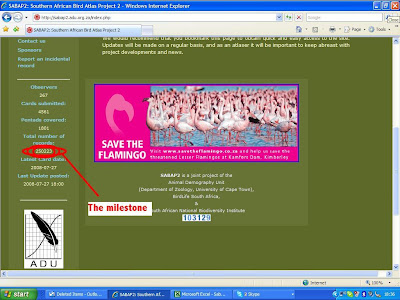
The atlasers for SABAP2 did a sterling job by submitting the first quarter million records by 18:00 tonight (27 July 2008). Below is a screenprint of this milestone - read previous post as well... it tells more of the milestones.


25 July 2008

100 000 visits


On Tuesday 22 July 2008 just after 14:00 the SABAP2 website (http://sabap2.adu.org.za/index.php) had received a 100 000 hits. It was in the 13th month of the bird atlas project that this milestone had been reached.


After the 21:00 update tonight (25 July 2008) the project needed a mere 1 088 records of sightings to reach a quarter million records. If it is considered that the average number of records per day is just over 1 000, the quarter million mark should be reached by 21:00 on Saturday 26 July. Once again in the 13th month of the project.


Why don't you join us in the fun and start submitting your atlas records. Visit the SABAP2 website to find out more and how you can contribute to the research on the distribution and conservation of birds in Southern Africa.

26 June 2008

See ... and be seen!

I have won the wonderful support of the many farm owners in our district for SABAP2 and after asking their permission they allow me to roam their farms freely. The only problem is the ever present possibility of a criminal element. Most of the farmers in our area are stockfarmers and stock theft is a great problem. Some of the farmers asked me to find a way to make myself more visible to themselves, their workers and the SAPS patrolling the farm roads as any vehicle moving slowly along in the farming areas is treated with suspicion. The outcome was to have these door magnets made by a local signage firm. When I am out atlasing in the district I always have them on my car doors. The effect is that some of the farm workers now know the reason for my visit and they point out interesting observations they have made since my last visit to me. It helps me to get them involved in SABAP2 by reporting sightings to me and I have a way to engage with them about conservation in general and birds in particular. Even in town people stop and ask me about the magnets and I have a nice point of contact to get them interested. Now I can go out to see the birds ... and I am seen for who I am.

22 June 2008

Swainson's Spurfowl trekking south

The first year of SABAP2 is nearly finished and I have observed the following range expansion of the Swainson's Spurfowl (Pternistis swainsonii) in my surveys. After Deon du Plessis commented (see post of 25.05.2008) on his observations of this species through the 1990's, I started to look out particulartly for them. On 16.06.2008 I observed 5 birds in a small family covey along the Melkspruit at S30.76249 E26.65912 (in pentad 3045_2635 and QDGC 3026DC). The birds were foraging near the edge of a fallow land – nearer to the taller growth where there were enough protection should the need to hide arise.

This is the most southerly of my own observations thus far – 16,5km more southwest than the spots Deon had mentioned in his comment. It corresponds with Deon's suggestion that the birds expand their range along the rivers and streams – especially with the abundance of food in cultivated lands and where other agricultural activity suiting them occur. Interestingly enough my observations of these birds here on the southwestern border of their range were always in the vicinity of generous water supply – larger farm dams that would have water through the dry season and perennial streams. According to the literature, they normally drink very regularly - in the morning and evening.
For the most up to date distribution map of the species, follow this link: http://sabap2.adu.org.za/species_maps.php?Spp=185

08 June 2008

Thin blue lines

(Click to enlarge)


The thin blue lines on the image are the different tracks that I have driven to survey the area for the 2nd Southern African Bird Atlas Project in the larger Aliwal North area. The squares are the pentads (see earlier post for description) in which the surveys are done according to the research protocol. The tracks are recorded with a Garmin GPSmap76 CS receiver with an external aerial. These are only the tracks that I have driven - the GPSr is mounted in the car and is just too much trouble to remove and refit it every time I get out to walk to a ridge, a dam or an outcrop to scan the area for bird activity. On average the distance traveled within a pentad is between 35 and 40km - excluding the distances walked away from the stationary vehicle.


I prepare the outlines of the pentads beforehand and then upload it from computer to the GPSr before I go out on the field surveys. This way I know the borders of the different pentads clearly - ask permission from land-owners - and go out in the field and enjoy myself while atlasing. I like to use the available technology to help me enjoy the atlasing project and birding in general. When scarcer species and larger raptors are observed, I record a GPS waypoint and these are fed into my database of sightings and nesting spots.

01 June 2008

Emerging trends #1

A first interesting trend is emerging from the data that I have collected for SABAP2 - the second bird atlasing project in Southern Africa.


(Click on graph to enlarge)
The accompanying graph shows the averages of species observed in different months after the first 11 months of the project.

A difference of 16.8 species is seen between the highest (summer) and lowest (winter) averages. The migratory birds had left and the change in weather conditions as well as seasonal migration can all be possible explanations for the development of this trend.

The data of 103 field sheets is included in the calculation of the averages - no surveys had been done at the very beginning (July 2007) and June 2008 will be the last month of the first year.

The surveys were done in 57 different pentads - from the Western Cape (including the West Coast, Swartland and Karoo), Eastern Cape (from the sea towards Aliwal North on the Orange River), North West Province and different parts of the Free State.

The project is still in the very early stages and this trend is by no means a picture of the whole project. What is reflected here, are my own observations from data in my personal database.

Please return to the blog to witness the moves and trends developing over time or visit http://sabap2.adu.org.za/index.php for up to date information on SABAP2.

25 May 2008

The Aliwal Quarter Degree Cell after 11 months

SABAP2 is the second project of it's kind and builds on the successful completion of SABAP1 - The Southern African Bird Atlas Project. I would like to report on my participation in the atlas project in my home area - so to find out more about SABAP2 as a project follow this link: http://sabap2.adu.org.za/index.php Click to enlarge map
Each of the squares represents 5'X5' on the map. Such a "pentad" is roughly 9 km long (North-south) and 7 km wide - 63 square km. The pentads are counted from left to right - top to bottom. The pentads are identified by the pentad code in the NW-corner (top left) and each have a "common name" indicated by the little green flag in the centre of the square. The code is derived from the map grid and the common name is given by the atlaser in the area - so different atlasers can give different common names to the same pentad. I have used the name of the farm more or less in the centre of the pentad as the common name for that specific pentad. The research protocol requires of the atlaser to count at least 2 hours in the specific pentad trying to cover all habitats - eg vleis and wetlands, cultivated fields, riverine bush, koppies, grassveld, plantations, dams, etc. A data period does not exceed five days for the same pentad - after 5 days a new data card is started with the prescribed 2 hour minimum.
After 11 months (since July 2007) of counting the different bird species in the squares demarcated by the lines on the map, I can report the following "findings" - these are merely my own observations:
  • For all the pentads in the Quarter Degree Cell 2 data cards were completed - except 9 (11 cards - this pentad is counted daily as I move around town).
  • In the full QDGC 176 different species were counted in the previous atlas project (then the QDGC was counted as a whole and 68 data cards were submitted over the period 1987-1991). Up to now I've counted 172 unique species with a few out of range species that still have to be vetted. 27 data cards were submitted for SABAP2.
  • For each of the different pentads the count is: Zuurplaat - 88 unique species, Strydpoort-Winplaats - 75, Jakkalsfontein - 76, Badfontein - 107, Betjeskraal - 88, Waaiplaats - 89, Gryskoppan - 63, Ackermanskraal - 92, Aliwal-Dorp - 119.
  • In the last round of counts (the last month) the migratory birds had already left for winter - counts were remarkably lower than in summer counts.
  • Some of the interesting species (not necessarily "new" species) observed in these 9 pentads are the following: Goliath Heron, Southern Pochard, African Marsh Harrier, Swainson's Spurfowl, Crested Barbet, Willow Warbler, Spotted Flycatcher, Fairy Flycatcher, Kimberley Pipit, Red-backed Shrike, Red-billed Firefinch, Brimstone Canary (Unvetted records are not included in this list).

One of the aims of SABAP2 is to research the influence of climate changes over the past 20 years on the distribution of different bird species. After the first 11 months some species were found in this area that were not previously found here - the Swainson's Spurfowl is an example. It is too early in the research yet to make an unqualified deduction that this species has expanded it's range in a southwesterly direction. Early indications are that a range expansion may have occured as these species were not previously observed this far south. (It was observed more than once in the Smithfield area as well).

The project is not yet under way for a full year, and a lot of counting must still be done in the next few years. To participate in the atlas project is really satisfying for me as birder. I also want to thank the many farmers in the area that allow me to enter their properties and roam about freely to participate in this project of the Animal Demographic Unit (ADU at UCT), BirdLife South Africa (BLSA) and the South African National Biodiversity Institute (SANBI). Together with these organisations and hundreds of other atlasers countrywide, we make a contribution to the conservation of birdlife and their habitat.